

Last Updated: November 8, 2026
Quick Summary
No, free shipping is not always better value. A zero delivery fee can be offset by a higher item price, so compare the final checkout total for the same basket. Include any tax and check the returns terms before deciding.
- Compare the total at checkout for the same delivery address, not the product page price.
- On a single low-value item, free delivery usually wins; on a multi-item basket, paid delivery often does.
- Subtract the lower item price from the higher one, then divide by the delivery fee to find your break-even.
- Check the minimum spend for free delivery and whether a discount code could drop you below it.
- Factor in return postage and the returns window, since a return can outweigh a delivery saving.
Table of Contents
- Why Free Shipping Does Not Always Mean Lower Cost
- Free Shipping vs Lower Prices: Which Saves More?
- How Free Shipping Thresholds Change the Maths
- How to Compare Online Prices on a Like-for-Like Basis
- Why Returns Policies Change the Real Cost of an Order
- Shipping Speed, Service and Perceived Value
- Checking Your Next Order Before You Pay
- Frequently Asked Questions
Why Free Shipping Does Not Always Mean Lower Cost
Free shipping is one of the most persuasive offers an online shop can make. Yet a zero delivery fee does not automatically mean you are paying less. Shoppers often judge orders by the headline offer rather than the final total, which is why this comparison matters. The honest answer to whether free shipping is always better value is no. It depends on what the item costs, how it is priced, and what else comes with the order.
Shipping is a cost someone pays. When a retailer removes the delivery fee, the cost usually shows up somewhere else, such as the item price, the minimum spend or the returns terms. A useful question to ask is simple: what is the total cost of this order, delivered to my door, compared with other options? That is the figure that decides value.
Free Shipping vs Lower Prices: Which Saves More?
A lower item price with paid delivery can cost less than a higher price with free delivery, but the gap is rarely as wide as the headline suggests. To weigh cheap against quality, learn how to spot durable utility products before you buy. The only reliable way to judge is to compare the delivered total for an identical basket, including any tax that is calculated on the item price rather than the delivery fee.
Take a single item. Consider two retailers with different delivery structures. Compare the delivered total for an identical item in each case, rather than relying on the delivery label alone.
Tax can also affect the comparison. If you are buying for a business and reclaim VAT, check how each retailer shows delivery and VAT, because the recoverable amount can differ between the two structures.
Basket size changes the answer again. On a single low-value item, a delivery fee is a large proportion of the total, so free delivery tends to win. On a basket of several items, the delivery fee is spread across more goods, so a lower item price with paid delivery often comes out ahead. The same delivery fee can represent a very different share of the total depending on how many items are bought.
Shoppers also differ in how they weigh the two structures. Many shoppers abandon a basket when a delivery charge appears late, while others prefer a lower item price and accept the fee. Neither preference is irrational. The first group is pricing certainty and avoiding checkout surprises; the second is optimising the sticker price and is willing to absorb a known fee. A useful habit is to decide which group you are in before you start comparing, then apply that rule consistently rather than switching depending on which total looks better.
Watch out: a free-delivery offer can be paired with a higher item price that only becomes visible once you compare the same product elsewhere, so always check the item price and the delivery fee as two separate numbers before you judge the total.
For sellers, free delivery is a marketing cost that has to be recovered through margin, volume or a higher item price, which is why it is often offered on higher-value baskets or products with enough margin to carry it.
The table below sets out the two main ways a retailer can price an order, so you can compare the delivered total rather than the headline offer.
| Pricing approach | Where the cost shows up | What to compare |
|---|---|---|
| Free delivery | Higher item price or minimum spend | Item price plus any tax, against the paid-delivery total |
| Lower item price with paid delivery | Separate delivery fee at checkout | Item price plus delivery fee for the same basket |
| Small single item | Delivery fee is a large share of the total | Free delivery usually wins |
| Multi-item basket | Delivery fee spread across more goods | Lower item price with paid delivery often wins |
How Free Shipping Thresholds Change the Maths
Many retailers offer free delivery only above a minimum spend, and that threshold is one of the most powerful levers in online retail because it changes what shoppers put in the basket, not just whether they buy. A shopper with £18 in the basket may add a second item just to reach the threshold, even when they did not plan to buy it.
Consider a basket that sits just below a free delivery threshold. Adding an item to reach the threshold only saves money if the extra item was needed anyway. That is the shopper's side of the calculation.
The seller's side is where the real decision sits. A threshold works when the extra margin from the added items exceeds the delivery cost the retailer absorbs. A threshold lifts average order value only if enough shoppers top up rather than abandon. Set it too high and shoppers leave; set it too low and the retailer absorbs delivery on orders that would have been placed anyway.
A practical break-even check for a shopper runs like this. Subtract the lower item price from the higher one, then divide that gap by the delivery fee you would otherwise pay. If the answer is a spend level or a number of items you would reach anyway, the free-delivery option is likely better value. If not, the cheaper item with delivery usually wins. For a seller, the equivalent check is to set the threshold so that the extra margin from top-up spend covers the delivery cost, which is why thresholds are usually set in round numbers a little above the natural basket size.
Thresholds also interact with promotions. A discount code that reduces the basket below the threshold can remove free delivery and leave the shopper worse off than if they had not used the code. Retailers that apply the threshold to the pre-discount total avoid this; those that apply it post-discount create a trap that erodes trust. Shoppers should check which rule applies before applying a code.
Different shopper segments respond differently. A planned purchase, a replacement item, a specific gift, is less likely to trigger a top-up, because the shopper knows what they need. A browse-driven basket is far more likely to cross the threshold, which is why thresholds work best on categories where discovery is part of the experience. Urgent purchases are the least responsive of all: a shopper who needs something quickly will pay the delivery fee rather than wait to build a larger basket.
Watch out: a threshold that is met only by adding an item you would not otherwise buy is a cost, not a saving, and the same logic applies to a retailer that sets a threshold so high that it converts a sale into an abandoned basket.
How to Compare Online Prices on a Like-for-Like Basis
!A shopper at a kitchen table comparing two checkout screens on a laptop, with a notepad and pen beside them
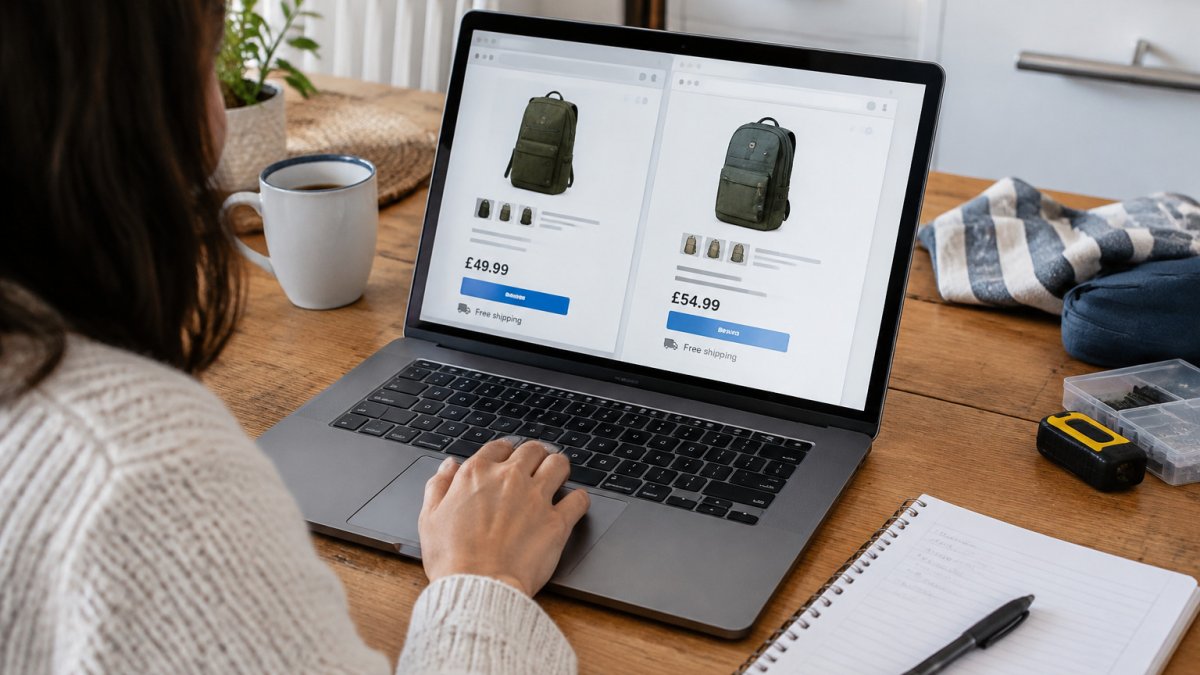
Comparing online prices fairly requires matching the details. Check that the product, size, colour, quantity and condition are identical. Then compare the final checkout total for the same delivery address, not the price shown on the product page.
Many shoppers stop at the first total they see. Instead, run the checkout up to the payment step for each retailer and note the figure. Remember to include any service charges, and to check whether discount codes apply only to certain payment methods. Once you have the totals side by side, the cheapest option is clear.
A Simple Break-Even Check
A quick way to test value is to work out your break-even point. Subtract the lower item price from the higher one, then divide that gap by the delivery fee you would otherwise pay. If the answer is a number of items or a spend level you would reach anyway, the free-delivery option is likely better value. If not, the cheaper item with delivery usually wins.
Why Returns Policies Change the Real Cost of an Order
Delivery is only half of the cost picture. If you return an item, the return postage, time and inconvenience can outweigh a saving on shipping. A retailer offering free returns can therefore be better value, even when its delivery charge is higher.
NEXZI offers a 30-day returns policy, which gives shoppers time to check fit and function. When comparing retailers, look at the cost of a return, who pays for it, and how long you have to send an item back. A lengthy window with free returns reduces the risk of ordering the wrong item.
Shipping Speed, Service and Perceived Value
Value also depends on how quickly and reliably an order arrives. A cheaper delivery that takes two weeks may not suit a gift needed for a specific date. Likewise, a fast delivery that arrives damaged is no bargain.
Perceived value matters too. A clear delivery policy, visible from the start, builds trust. Many shoppers feel more comfortable with a retailer that shows its full costs early. Hidden charges at the final step often leave people feeling misled, even if the total is competitive.
NEXZI uses 100% SSL encrypted payments, so the checkout is secure while you compare. Transparent pricing and a secure payment process make it easier to judge the real value of an order.
Checking Your Next Order Before You Pay
Before you confirm your next order, run through a short check. Compare the total at checkout, not the headline price. Note any delivery fee and the spend needed to remove it. Ask whether any extra item is one you would buy anyway. Check the returns terms and the expected delivery time.
Small everyday items can also help you reach a threshold without wasting money. These are a practical example of a low-cost addition that many shoppers find useful at home.
Free shipping is often good value, but only when you compare the full cost of the order. Run the numbers each time, and the best deal usually becomes obvious. Ready to compare? Browse the NEXZI range and check your total before you order.
Frequently Asked Questions
Is free shipping always better value?
No. Free shipping is only better value when the total you pay, including the item price, is lower than the same item with a cheaper delivery charge elsewhere. Retailers often build delivery costs into product prices, so the headline 'free' figure can hide a higher basket cost. Compare the final checkout total for the same item, quantity and delivery date before deciding. Check whether a threshold applies, and note whether returns are free, since a return fee can cancel out any saving on delivery.
Is it cheaper to pay for shipping or choose an item with free shipping?
It depends on the total. Paying a shipping fee on a lower item price is often cheaper, but only if the combined total is lower. Add the item price and the delivery charge for each option, then compare the two final figures. Watch for threshold offers, where you may need to spend more to qualify, and for returns costs if you think you might send something back.
Can a free shipping threshold make an order more expensive?
Yes. A threshold can encourage you to add items you did not plan to buy just to reach the free delivery level. If the extra items cost more than the delivery fee you would have paid, the order ends up dearer. Work out the spend needed to qualify, then ask whether you would have bought those extra items anyway.
What should I check before placing an online order?
Check the final checkout total, not the item price alone. Look at the delivery fee and whether it changes with order value, the returns policy and any return costs, and the delivery date. Confirm the payment is secured by SSL encryption, shown by a padlock in the browser address bar. Compare the same item across two retailers using identical quantities and options.


