

Quick Summary
A durable car boot organiser is one with a rigid base, reinforced stitching at handles and corners, and straps that anchor it to the car's tie-down points. Measure the usable floor at its narrowest points, between the wheel arches, at the tailgate opening and at the base of the seat backs, and buy to those figures.
- Measure the boot at its narrowest points: between wheel arches, at the tailgate opening and at the seat-back base.
- Check handle anchors and corner joins for reinforced, wrap-around stitching rather than a single seam.
- Choose a rigid base plate, since soft bases fold under weight and let the unit slump.
- On hard plastic liners, rely on tie-down straps, because passive non-slip pads will not hold.
- Keep heavy items low and near the back seats, and tighten straps before every journey.
Table of Contents
- Why Most Car Boot Organisers Fail Within Months
- Car Boot Organiser Size Guide: Matching Dimensions to Your Boot
- Materials and Build Quality That Actually Last
- Durable Car Boot Storage: Features Worth Paying For
- Non-Slip Car Boot Organiser Designs and How They Grip
- How to Organise a Car Boot Once You Have Chosen
- Choosing Your Organiser and Ordering From NEXZI
- Frequently Asked Questions
Why Most Car Boot Organisers Fail Within Months
Last Updated: October 30, 2026
Most car boot organisers look sturdy on the product page and fall apart by the second school run.
Organisers are judged on looks and capacity, but the real stress falls on seams, bases and fasteners, a boot load shifts constantly, testing the weakest point.
Here is what usually goes wrong:
- Seam failure: Stitching that is too light or too widely spaced tears where the handles attach.
- Base collapse: Soft, unstructured bases fold under weight, so the whole unit slumps toward the rear seats.
- Sliding: Without grip on the base, the organiser travels every time you brake or corner.
The fix is not to buy the most expensive option but to match the design to how you use your boot.
Car Boot Organiser Size Guide: Matching Dimensions to Your Boot
Telling you to measure your boot is technically correct but practically useless, because numbers alone do not tell you whether an organiser will fit. For a broader look at accessories that keep the boot and cabin organised, explore car accessories for road trips. Boot floors are interrupted by wheel arches, load lips, seat-back angles and tailgate curves, and those interruptions vary by vehicle type.
Start with the usable floor, not the maximum dimensions
Manufacturers quote boot volume in litres, but that figure is measured to the roof and often includes unusable space under the parcel shelf.
Boot floors often narrow toward the tailgate, and the height at the opening can be noticeably lower than at the seat backs. Measure the height at the opening as well as at the seat backs, and buy to the smaller figure.
How boot shape differs by vehicle class
The same nominal boot volume can hide very different usable shapes. Here is what to expect from the main vehicle classes:
- Hatchbacks (e.g. Fiesta, Polo, Corsa): Short floor length, often 60-75 cm, with a pronounced load lip and intruding wheel arches. A tall, narrow organiser with a footprint under 60 × 40 cm is usually safest.
- Saloons (e.g. Mondeo, Passat, 3 Series): Long floor but a low, narrow tailgate opening and deep load lip. A low-profile organiser that slides under the parcel shelf works better than a tall one, many saloon owners find 30 cm is the practical maximum height.
- SUVs and crossovers (e.g. Qashqai, Tucson, Sportage): The most organiser-friendly shape: flat floor, tall opening and modest wheel-arch intrusion. If you use a retractable parcel shelf or cargo cover, measure from the floor to its underside in the closed position, not to the roof.
If you are unsure which class your car falls into, check the make and model in your vehicle documents and cross-reference them against the manufacturer's published boot dimensions.
Account for wheel arches, load lips and seat-back rake
Three features catch out most buyers:
- Wheel arches. In many hatchbacks and small SUVs the arches protrude 10-20 cm into the floor on each side. Measure the width between the arches, not the widest point, an organiser wider than the gap will sit on top of them and tilt.
- Load lip. The raised sill at the tailgate opening can be 5-15 cm high. A unit with a grab handle on the rear face, or one light enough to lift with one hand, is easier to live with.
- Seat-back rake. Rear seats are rarely vertical, and a raked seat back reduces usable floor length at the top. Measure floor length at the base of the seat backs, and if the organiser is taller than about 30 cm, check its top edge clears the rake.
Volume versus footprint: what the litre figure really tells you
A 50-litre organiser and another 50-litre organiser can have completely different footprints, because volume is length × width × height. For most drivers, footprint matters more than volume, because the floor is the constrained dimension.
Aim for an organiser that covers 60-80% of the usable floor area, leaving a margin on each side for sliding in and out, access to tie-down points, and to prevent rubbing against trim.
Check the fit before you commit
If buying online, compare the organiser's stated dimensions against your three measurements and allow at least 2-3 cm of clearance on each side. If the product page does not state the internal dimensions as well as the external ones, ask before ordering, thick walls can lose several centimetres of usable width.
Materials and Build Quality That Actually Last
Material choice does more to determine lifespan than any feature list. Look for a strong outer fabric, reinforced stress points and a base that holds its shape under load.
Fabric Weights, Stitching and Rigid Bases
Heavier fabrics resist abrasion and tearing far better than thin ones.
Stitching matters as much as the fabric.
A rigid base plate keeps the organiser level and stops the sides collapsing inward, while non-slip strips or a textured underside grip the boot floor. For anything carrying heavier kit, prioritise rigidity.
Wear Points to Inspect Before You Buy
Before you commit, check the places an organiser is most likely to give out:
- Handle anchors: Confirm the handles are sewn through a reinforced panel, not just stitched to the outer fabric.
- Corner joins: Look for stitching that wraps the corners rather than relying on a single seam.
- Divider attachments: Check how internal dividers are secured and whether the hook-and-loop strips are sewn or glued.
The article points to a short set of wear points and build features to check before buying, summarised below.
| Check | What to look for | Why it matters |
|---|---|---|
| Handle anchors | Handles sewn through a reinforced panel | Stops handles tearing away from the fabric |
| Corner joins | Stitching that wraps the corners | Avoids reliance on a single seam |
| Divider attachments | Hook-and-loop strips that are sewn or glued | Keeps internal dividers secure |
| Zips and closures | Fully covered teeth and a smooth track | Prevents snagging and jamming |
| Base | Rigid base plate with non-slip strips or textured underside | Keeps the unit level and stops it sliding |
Durable Car Boot Storage: Features Worth Paying For
Not every feature earns its place. Focus on the ones that affect how the organiser performs over months of use.
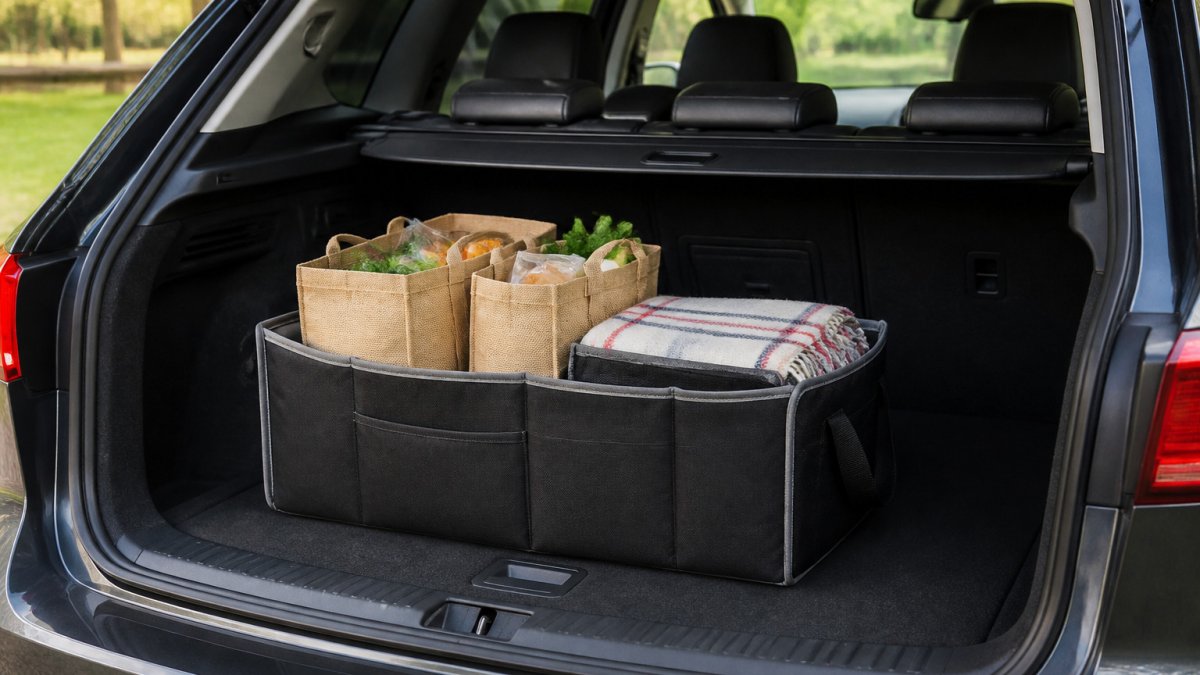
Securing mechanisms rank highest. Straps or hooks that anchor the unit to the boot's tie-down points stop it moving on corners and under sudden braking, look for adjustable straps with solid buckles rather than basic loops.
Portability matters if you move the organiser between cars or take it indoors to empty.
Waterproof and weather-resistant finishes are worth having if your boot takes wet kit, dog towels or camping gear.
Non-Slip Car Boot Organiser Designs and How They Grip
Sliding is the most common complaint about boot organisers, and it is almost always a grip problem rather than a size problem. But "non-slip" is used loosely by manufacturers, and the mechanisms behind the claim vary enormously in effectiveness.
The four main grip mechanisms
Most organisers rely on one or more of these approaches:
- Rubberised feet or pads. Small rubber or thermoplastic elastomer (TPE) pads create friction against boot carpet. They work well on carpet and rubber mats but poorly on smooth plastic liners or bare metal. Glued pads can peel off; stitched or riveted pads last longer.
- Full-base non-slip panels. A continuous rubberised or textured panel provides more contact area than feet and resists sliding in any direction. Generally the most effective passive grip on carpet, but it adds weight and can trap grit unless removable for cleaning.
- Hook-and-loop (Velcro-style) strips. These work only if the boot carpet has a loop pile the hooks can grab, many modern liners are too tight or too smooth. They also degrade as they fill with lint and debris.
- Tie-down straps and hooks. Straps anchored to the car's tie-down points or seat-back hooks prevent movement entirely, regardless of floor material. This is the only mechanism that works reliably on smooth plastic or hard liners.
Match the mechanism to your boot floor
The right grip design depends on what is on your boot floor:
- Carpet or loop-pile mat: Rubberised feet or a full-base non-slip panel work well, and hook-and-loop can work if the pile is deep enough.
- Rubber or thermoplastic mat: Rubber pads provide moderate grip; full-base panels are better. Hook-and-loop will not hold, so straps are the most secure option.
- Smooth plastic liner or bare metal: Passive grip designs are largely ineffective. Choose tie-down straps, or add a non-slip mat underneath as a separate layer.
If your car has a hard plastic boot liner, common in many SUVs and estates, do not assume a "non-slip base" will hold. The most reliable setup is an organiser with both a rubberised base and adjustable straps that clip to the car's tie-down loops.
How to test grip before you buy
You can assess grip in the shop or once the organiser arrives:
- Place the empty organiser in the boot and push it gently from the side. It should resist sliding on its own.
- Load it with a realistic weight, a full shopping bag or a toolbox, and repeat the push test.
- If the organiser has straps, clip them to the tie-down points and repeat the test. The unit should not move at all.
- Check the base after a week of use. If the non-slip pads are already compressed, peeling or clogged with debris, the design is not fit for purpose.
The safety angle most guides ignore
Grip is not just about tidiness, it is a safety issue. An unsecured organiser and its contents become projectiles under heavy braking or in a collision. Straps that anchor the organiser to the car's load-restraint points are the only reliable way to prevent this. If your car has no tie-down points, consider a boot mat with integrated lashing eyes, or choose an organiser small and light enough to be wedged securely between the seat backs and the tailgate.
Design features that improve grip over time
A few details separate organisers that stay put from those that loosen after a few months:
- Adjustable straps with metal buckles hold tension better than elastic cords or plastic clips, which stretch and crack.
- Straps that run under the base rather than across the top keep the organiser flat against the floor and prevent it lifting under load.
- Removable non-slip panels can be washed, which restores grip when the surface becomes clogged with grit and pet hair.
None of these features is expensive to manufacture, but they are rarely mentioned in product listings. Check the product details for strap material, buckle type and whether the non-slip base is removable.
How to Organise a Car Boot Once You Have Chosen
Once you have your organiser, place the heaviest items low and near the back seats, where they sit most stably. For a complete method covering the rest of the car, see how to tidy the whole car interior.
Use the dividers to separate categories. Keep the emergency kit in one compartment, cleaning supplies in another and anything that may leak in a sealed bag.
Review the setup every few weeks. Loads change with the seasons, and a layout that suited the summer picnic kit may be wrong for winter wellies and a shovel.
Choosing Your Organiser and Ordering From NEXZI
When you compare options, work through the same checklist: measure the boot, confirm the fabric weight and stitching, check the base for rigidity and grip, and make sure the securing straps suit your car's tie-down points. You can browse related car and desk accessories to find what else suits your setup.
NEXZI stocks a range of automotive storage and organisation products designed for everyday use. Every order includes free shipping and free 30-day returns, so you can test the fit in your own boot without committing.
Read the product details against the checklist in this guide, measure your boot again if you are unsure, and order when you are confident the dimensions and build suit your car.
Frequently Asked Questions
How do I choose the right size car boot organiser?
Measure your boot's usable width, depth and height, including the wheel arches and any load cover position, then compare these against the organiser's folded and open dimensions. Allow a few centimetres of clearance so the organiser does not press against the tailgate or block the rear seat release. Check that it fits when the rear seats are folded as well as upright, since that is when most boots have the most usable space. Measuring in millimetres and centimetres before you order avoids returns and keeps the organiser stable on the floor.
What material makes a car boot organiser durable?
Heavy-duty fabrics such as 600D Oxford polyester resist tearing and abrasion better than thin nylon, and a rigid or semi-rigid base plate stops the organiser from collapsing under heavier items. Look for reinforced stitching at the corners and handles, since seams are usually the first point of failure. Water-resistant coatings help with spills and damp conditions. A well-built organiser made from these materials should hold its shape through regular daily use rather than sagging after a few months.
Are collapsible car boot organisers sturdy enough for heavy items?
Collapsible designs can carry moderate loads such as shopping, sports bags and tool kits, but their load-bearing capacity depends on the base and frame. For heavy items like water containers or camping gear, choose an organiser with a rigid base and reinforced sides, and avoid models that rely only on flexible panels. Check the manufacturer's stated weight limit and distribute heavier items low and near the centre to reduce strain on the seams and securing straps.
How do you stop a car boot organiser from sliding around?
Non-slip strips or a rubberised base are the most effective way to keep an organiser in place, particularly on carpeted boot floors. Hook-and-loop fasteners or securing straps that anchor to the boot's tie-down points add further stability when you brake or corner. Position the organiser against the rear seat backs or a side panel where possible, and avoid overfilling it so the weight stays low and balanced.
How do I organise a car boot so items stay put?
Start by placing heavier items on the bottom and closest to the rear seats, then use internal dividers or compartments to separate groups such as cleaning kit, sports equipment and shopping. Keep loose items in mesh pockets or fabric bins so they cannot roll across the floor. Store emergency items such as a warning triangle, first aid kit and torch in a consistent spot so you can reach them quickly. Check the arrangement after a few journeys and adjust anything that shifts.
Are car boot organisers worth buying?
A good organiser is worth buying if you regularly carry mixed loads, want to keep shopping and kit from sliding around, or need a boot that stays tidy for family or work use. Pricing depends on size, materials and features, so compare the build specification rather than the headline price. A cheap organiser that splits or collapses within months costs more over time than a durable one. For current prices and availability, check the NEXZI website.
How do I clean a car boot organiser?
Remove all contents and shake out loose debris first. Most fabric organisers can be wiped with a damp cloth and mild soap, then left to air dry fully before refitting to prevent mould. Check the care label for machine-wash guidance, and avoid harsh solvents that can degrade water-resistant coatings. Inspect stitching and base plates during cleaning, since spotting early wear helps you decide whether the organiser still offers reliable support.
What features should I look for in a car boot organiser?
Prioritise a sturdy base, reinforced stitching, non-slip underside, adjustable internal dividers and securing points that anchor to the boot. Water resistance and easy-clean fabric matter if you carry sports or outdoor kit. Foldable designs are convenient for storage when you do not need the organiser, but confirm the folding mechanism does not weaken the frame. Match the features to how you actually use the boot rather than choosing the most compartments.


