

Quick Summary
The best educational toys match the child's age and current skills, so start with the age range on the box and the skill it targets. Strong picks include sturdy shape sorters and puzzles for toddlers, building and magnetic sets for STEM learning, and strategy games or creative tools for ages 6 to 12. Choose open-ended toys that offer more than one route to success.
- Start with the age range on the box, then check which skill the toy targets.
- Toddlers benefit from sturdy shape sorters, stacking rings and chunky wooden puzzles.
- Building sets, magnetic tiles and marble runs teach spatial reasoning and cause and effect.
- Choose toys with more than one valid solution so children can change the outcome themselves.
- Check age grading and magnet warnings, and remove any damaged magnetic toys from use.
Table of Contents
- How to Choose Educational Toys by Age and Learning Goal
- Educational Toys for Toddlers and Early Learners
- STEM Toys for Kids: Building, Magnets and Problem-Solving
- Educational Toys for 6-12 Year Olds: Focus, Logic and Strategy
- Montessori Toys for Children and Learning Through Play
- Safety, Materials and Accessibility When Buying
- Choosing Your Next Educational Toy
- Frequently Asked Questions
Which Educational Toys Are Best for Kids?
Last Updated: November 7, 2026
How to Choose Educational Toys by Age and Learning Goal
Choosing educational toys for kids is easier when you start with two questions: how old is the child, and what do you want them to practise? Shoppers often jump straight to brand names and bright packaging, then wonder why the toy sits unused after a week. A toy that suits a four-year-old will frustrate a toddler and bore a nine-year-old.
Start with the age range printed on the box, then check the skills it targets. Fine motor control, counting, reading, problem-solving and focus all call for different designs. A good educational toy gives a child a clear challenge without needing constant adult help.
Watch out: age labels are a starting point, not a guarantee. A quieter child may enjoy a puzzle a year above their age, while a restless child may need something simpler to stay engaged.
Matching Toys to Developmental Stages
Developmental stages shape what a child can manage. Toddlers learn best through touch, stacking and cause-and-effect play. Preschoolers begin matching shapes, colours and letters. School-age children are ready for multi-step building, strategy and longer projects.
Match the toy to where the child is now, not where you hope they will be. A toy that is slightly easy for a child is usually more useful than one that causes frustration. For a calming light-based option, see the ocean wave LED night light projector.

Educational Toys for Toddlers and Early Learners
Toddlers need educational toys for toddlers that are sturdy, simple and safe to mouth. Shape sorters, stacking rings and chunky wooden puzzles build hand-eye coordination and early problem-solving. Light-up sensory toys can hold attention for short sessions, which suits young children who move quickly between activities. Try a light-up dancing octopus with movement sensing for interactive early-learning play.

For bath time or sensory play, an interactive toddler toy such as the Ice Cream Bubble Machine keeps hands busy and encourages simple cause-and-effect learning. Keep sessions short and supervise closely with water toys.
A common mistake is buying too many toys at once. Two or three well-chosen toys that a toddler returns to will teach more than a cupboard full of options they ignore.
STEM Toys for Kids: Building, Magnets and Problem-Solving
STEM toys for kids, covering science, technology, engineering and maths, reward curiosity and persistence. The strongest ones share a common design: they let a child change the outcome themselves. If a toy only does one thing, its educational value tends to end once the child works out how it operates.
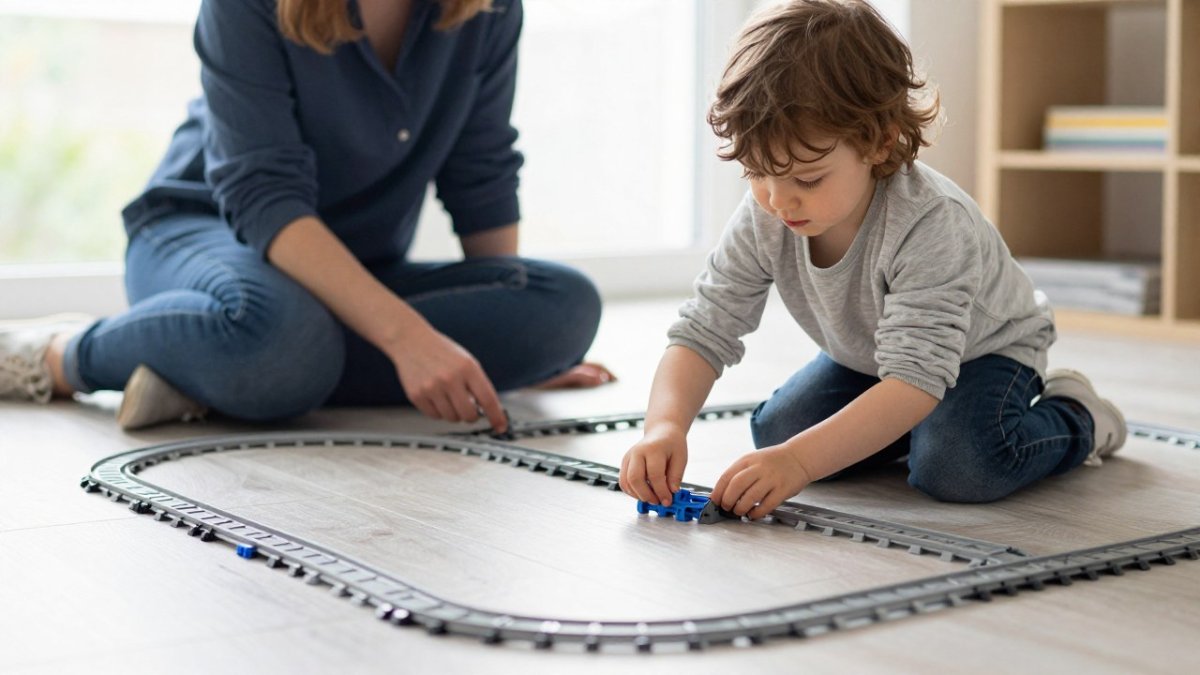
It helps to know which skill each type of STEM toy actually practises, because the category is broad and the packaging rarely explains the difference.
- Building and construction sets (interlocking bricks, magnetic tiles, wooden planks) build spatial reasoning, symmetry and structural thinking. A child learns that a wide base stabilises a tall tower, and that some joints flex while others hold rigid.
- Magnets and magnetic tiles teach polarity and attraction versus repulsion through direct handling. They are quick to assemble, which suits children who lose patience with fiddly connectors.
- Track and marble-run systems introduce gradient, momentum and sequencing. Children adjust ramp height and corner angles to keep a ball moving, which is early cause-and-effect reasoning.
- Simple circuits and electricity kits (bulbs, buzzers, switches) show that a circuit must be closed to work. These suit children around seven and up who can follow a diagram.
- Coding and logic toys that use sequences of steps, rather than a screen, teach ordering and debugging: if the sequence is wrong, the outcome is wrong, and the child can see exactly where.
- Measurement and balance sets (scales, measuring cylinders, timers) make comparing, estimating and recording concrete rather than abstract.
The Magnetic Track Building Set with Electric Train is one option for school-age children who enjoy designing layouts. Its modular track sections let children combine pieces into different layouts and watch the electric train travel around them. Follow the manufacturer's age guidance and magnet safety warnings, and supervise younger children closely.
Watch out: small, high-strength magnets are a serious hazard if swallowed, and damaged magnetic toys should be removed from use immediately rather than repaired at home. Check the age grading and magnet warnings before purchase, and inspect magnetic sets regularly for loose parts.
In practice, the best STEM toys let children change the outcome themselves. Look for sets with more than one valid solution, spare parts, and instructions that show a principle rather than a single finished model. A kit that can be rebuilt into several designs will be returned to far more often than one with a single prescribed build.
The main STEM toy types and the specific skill each one practises:
| Toy type | Skill it builds | Typical age note |
|---|---|---|
| Building and construction sets | Spatial reasoning, symmetry, structure | Wide base stabilises towers |
| Magnets and magnetic tiles | Polarity, attraction and repulsion | Quick to assemble |
| Track and marble-run systems | Gradient, momentum, sequencing | Adjust ramp height and angles |
| Simple circuits and electricity kits | Closed-circuit cause and effect | Around seven and up |
| Coding and logic toys | Ordering and debugging steps | Visible sequence errors |
| Measurement and balance sets | Comparing, estimating, recording | Makes abstract ideas concrete |
Educational Toys for 6-12 Year Olds: Focus, Logic and Strategy
Children aged 6 to 12 can sustain longer projects and follow multi-step rules, but the range across those years is wide. A six-year-old is still building reading fluency and fine motor control; a twelve-year-old can plan ahead, hold several rules in mind and work independently for an hour. Match the toy to the child's current ability rather than the middle of the age band.
Strategy games, logic puzzles, construction kits and creative tools such as a simple 6.5-inch LCD writing and drawing tablet for sketching and note-taking all build concentration. The table below shows which skill each type of toy tends to develop, so you can pick by learning goal rather than by packaging.
- Strategy and board games (chess, draughts, deduction games) build planning, rule-following and the ability to hold a goal while responding to an opponent. They also teach losing gracefully, which is a genuine developmental skill.
- Logic and deduction puzzles (grid puzzles, brain-teaser books, single-player logic games) reward persistence and systematic thinking. They suit children who prefer to work alone and can self-check.
- Construction kits with moving parts (gears, pulleys, axles) extend building into mechanism. A child who can see why a gear train turns the wrong way is doing early engineering.
- Creative and design tools (drawing tablets, modelling sets, sewing and craft kits) build fine motor control and planning across multiple sessions. A project that spans several sittings teaches delayed gratification.
- Word and number games reinforce spelling, vocabulary and mental arithmetic through repetition that feels like play rather than drill.
- Long-form projects (model kits, coding workbooks, science experiment sets) teach sequencing, reading instructions and tolerating a slow build to a finished result.
Look for toys that offer open-ended challenges. A child who can plan, test and adjust will get more from a kit than one who simply follows a picture. A useful test before buying: does the toy have more than one route to success, and can the child tell whether they have succeeded without an adult marking it?
Watch out: toys that are too easy for a nine- or ten-year-old are abandoned quickly, while toys pitched two years ahead cause frustration and a sense of failure. If you are unsure, choose the simpler option and add a harder one later.
A practical pattern many families find works is to keep one strategy game, one construction set and one creative tool in rotation, swapping one out when the child stops returning to it. That keeps the shelf focused and makes it easier to see which skills are actually being practised.
Montessori Toys for Children and Learning Through Play
Montessori-style toys focus on hands-on, self-directed learning. They are usually made from natural or simple materials, have one clear purpose and let the child correct their own mistakes. Examples include wooden sorting boxes, bead frames and pouring sets.
Montessori toys suit children who prefer to work independently. They are less useful if you want a toy that provides lots of noise, lights or prompts. Choose based on how your child plays, not on the label alone.
Safety, Materials and Accessibility When Buying
Check the age grading, small-parts warnings and any magnet warnings before you buy. For under-threes, avoid small detachable pieces and choose toys with rounded edges. Look for clear manufacturer information about materials and cleaning.
Accessibility matters too. Choose toys with large buttons, high-contrast colours, tactile textures or adjustable difficulty where possible. Many toys can be adapted for children with different needs, so consider how your child physically and sensorily engages with them.
Watch out: electronic toys need batteries and charging, so check how they are powered and whether the packaging states safe battery handling.
Choosing Your Next Educational Toy
Start with the child's age and current skills, then pick one toy that targets a clear learning goal. Mix hands-on, construction and creative options over time rather than buying everything at once. Our range at NEXZI includes building, sensory and creative toys, so you can browse by age and learning goal to find the right match for your child.
Frequently Asked Questions
What are the best educational toys for kids?
The best educational toys match a child's age and a specific skill, such as early literacy, counting, construction or problem-solving. Open-ended options like building sets, magnetic tiles and puzzles tend to hold attention longest because children can use them in several ways. Check the age guidance on the packaging, look for sturdy materials, and pick toys that encourage hands-on exploration rather than only passive watching or tapping. Simple toys that a child can return to over months often give better value than novelty items used once.
Which educational toys are suitable for different age groups?
Toddlers benefit from shape sorters, chunky puzzles and stacking toys that build fine motor skills and early matching. Preschoolers do well with alphabet and counting games, simple building sets and pretend-play props. School-age children from 6 to 12 can handle more complex STEM kits, logic games and strategy-based toys. Always check the manufacturer's age range, because it reflects choking hazards and the skills the toy is designed to support.
Are STEM toys useful for children?
STEM toys introduce basic ideas in science, technology, engineering and maths through hands-on construction and experimentation. Building sets, magnetic tiles and simple circuit or track kits help children practise spatial reasoning, sequencing and cause-and-effect thinking. Their value depends on how they are used: guided questions from an adult, such as what happens if you change one piece, extend the learning. Follow the packaging for age guidance and any magnet safety warnings, and supervise younger children during play.
How can I choose a safe educational toy for a child?
Start with the age range on the packaging and check for small parts if the child is under three. Look for well-made items from sturdy materials such as ABS plastic or solid wood, and inspect seams, batteries and magnets before giving them to a child. Read any assembly, charging or use instructions and keep them for reference. Toys with small, strong magnets need particular care, so store them safely and supervise play. Adult supervision is advisable for any toy with electrical parts.


