

Last Updated: November 1, 2026
Quick Summary
A personal safety alarm is a small, portable device that emits a loud siren when activated, drawing attention to someone in trouble and deterring an attacker. The right choice depends on your situation: standalone models suit daily walks, torch models suit low-light routines, and monitored models suit situations where a siren alone would not be enough.
- Standalone alarms need no subscription and no phone signal, making them dependable anywhere.
- Torch-combined alarms add a bright LED light, useful for finding a lock or step in the dark.
- Monitored alarms alert a response centre or contacts, but the monitoring subscription is an ongoing cost.
- Decibel ratings are not directly comparable between manufacturers, so treat a single dB figure with caution.
- Test the alarm on the first of every month and replace batteries on the manufacturer's schedule.
Table of Contents
- What a Personal Safety Alarm Does and Who Uses One
- Types of Personal Safety Alarms: Standalone, Torch Combined and Monitored
- Personal Alarms for the Elderly: Fall Detection and Easy Activation
- Lone Worker Personal Alarms: Audibility, Accreditation and Escalation
- Monitored Personal Alarms: Subscription Costs, Response Centres and Data
- Loudness, Battery Life and Real-World Limitations
- Booking or Ordering Your Personal Safety Alarm From NEXZI
- Frequently Asked Questions
What a Personal Safety Alarm Does and Who Uses One
A personal safety alarm is a small, portable device that emits a loud siren when activated, drawing attention to someone in trouble and deterring an attacker. Most units are pocket-sized, carried on a keyring or clipped to a bag, and designed to be pulled or pressed in seconds.
People buy personal alarms for very different reasons. Students walking home late, commuters using poorly lit paths, and lone workers visiting clients are the most common users. Some older adults buy them as a way to summon help after a fall or in an emergency at home.
The right choice depends on the situation. A loud standalone alarm suits a daily walk. A monitored device suits someone who lives alone and may not be able to shout. Start by identifying the scenario, then work back to the features that matter for it.
Types of Personal Safety Alarms: Standalone, Torch Combined and Monitored
There are three broad categories. Standalone alarms are the simplest: a siren that sounds when you pull a pin or press a button. They need no subscription and no phone signal, which makes them dependable anywhere.
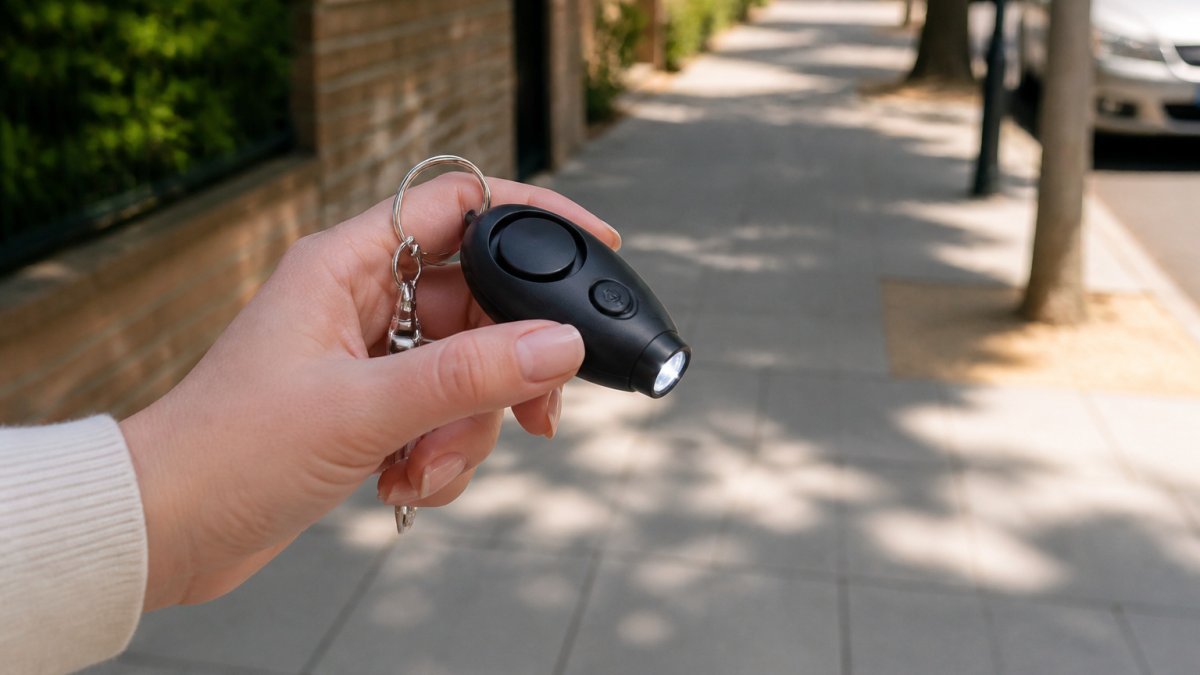
Torch-combined alarms add a bright LED light. The light helps you see in the dark and can disorient an attacker, and it is useful if you need to find a lock or a step.
Monitored alarms connect to a mobile network and, in some cases, GPS. When triggered, they alert a response centre or nominated contacts.
A practical rule: choose standalone for deterrence and general peace of mind, a torch model for low-light routines, and monitored for situations where a siren alone would not be enough.
The three categories differ mainly in cost, light and how help is summoned:
| Type | Best for | Key difference |
|---|---|---|
| Standalone | Deterrence and general peace of mind | Siren only, no subscription or signal needed |
| Torch combined | Low-light routines | Adds a bright LED light |
| Monitored | Situations where a siren alone is not enough | Alerts a response centre or contacts, needs a subscription |
Personal Alarms for the Elderly: Fall Detection and Easy Activation
For older users, the key features change. Activation must be simple. A large, clearly marked button or a pull cord that needs little grip strength works better than a small pin. Some devices include fall detection, which sends an alert automatically if the wearer falls and stops moving.
Fall detection is only as good as its settings and battery. Check how the device recognises a fall, how long it waits before raising an alarm, and whether the wearer can cancel a false alarm.
A common mistake is buying a tiny device that is hard to press when hands are cold or stiff. Test the activation method with the person who will use it before buying.
Lone Worker Personal Alarms: Audibility, Accreditation and Escalation
Lone workers need an alarm that others can hear and that escalates properly. Audibility matters most. A siren rated in decibels will carry further than a quiet one, but real-world sound depends on surroundings. Traffic, wind, and buildings all reduce how far a siren can be heard.
Look for independent testing or accreditation rather than marketing claims alone. Ask whether the alarm has been assessed by a recognised body and what the test covered. Escalation procedures matter as much as the device: decide in advance who responds, how quickly, and what happens if the alarm is raised but nobody answers.
Document your procedure and share it with everyone who may need to respond. An alarm without a plan can leave a worker waiting for help that never comes.
Monitored Personal Alarms: Subscription Costs, Response Centres and Data
A monitored alarm is really two purchases: the device, and an ongoing service. The service is where the real cost often sits, and it is the part buyers most often overlook. Before committing, work out the total cost of ownership over the period you expect to keep the alarm, typically three to five years for an older user.
Build the figure from these components:
- Upfront device cost. One-off, but check whether the device is locked to the provider's service or can be used with another.
- Monthly or annual monitoring fee. This is the main recurring cost. Plans are commonly sold monthly or annually, and annual plans sometimes carry a discount, but they also lock you in for longer.
- Connection or SIM charge. Some providers include the SIM in the subscription; others bill it separately, and some charge for SIM replacement when it expires.
- Battery or charging costs. Rechargeable units cost electricity; replaceable units cost cells. Neither is large, but both belong in the sum.
- Cancellation terms. Check the notice period, any early-termination charge, and what happens to the device if you stop paying. A device that becomes a paperweight without a subscription is a very different proposition from one that still works as a standalone alarm.
Ask the provider for the total payable over 12, 24 and 36 months, including any activation or SIM fees. A provider that cannot or will not give you that figure in writing is telling you something useful.
What the response centre actually does. Ask where the centre is based, what hours it covers (24/7 versus office hours), and what happens when an alert arrives. A typical sequence is: the operator attempts voice contact through the device's speaker, then calls nominated contacts, then escalates to the emergency services if there is no response. Confirm the escalation order and the expected response time, and ask what happens if the device cannot establish a voice call, some fall back to a data alert, some do not.
Data, privacy and false alarms. Connected alarms may collect location, activation history and audio. Under UK data protection law, a monitoring provider should tell you what it collects, why, how long it keeps it, and who it shares it with (ico.org.uk).
False alarms are normal and should be planned for. Find out how to cancel an alert from the device, how long the cancellation window is before contacts are called, and whether repeated false alarms affect your service.
Contract and consumer rights. Consumer protection law in the UK generally expects monitored services to be performed with reasonable care and skill (Consumer Rights Act 2015).
Do not assume a monitored alarm will summon help if you cannot speak. Confirm in writing how the provider handles silent activations, no-response situations and loss of mobile signal at your address.
Pricing for monitored services varies by provider, plan length and included features, and subscription prices change.
Loudness, Battery Life and Real-World Limitations
Loudness is quoted in decibels (dB), usually measured at one metre from the device. That figure is a useful starting point for comparison, but it is not a prediction of whether anyone will respond. Loudness is quoted in decibels (dB), but the figure is a starting point for comparison rather than a prediction of whether anyone will respond.
What actually determines whether an alarm attracts attention:
- Distance and obstructions. A single brick wall or a closed car window can knock 20-30 dB off what a listener hears. An alarm sounding inside a handbag, a coat pocket or a rucksack is muffled by fabric and body shielding.
- Background noise. Urban traffic, building work, pubs and train stations routinely sit at 70-85 dB. An alarm has to rise well above that to stand out, and the ear is better at detecting a change in sound than a steady one, which is why a pulsing siren often works better than a continuous tone.
- Hearing ability of bystanders. Age-related hearing loss is common from the mid-60s upward, and high-frequency sirens are the first thing to become inaudible. A lower-frequency, two-tone alarm may be more reliably heard by the people most likely to be nearby.
- Placement. A device clipped to a shoulder strap or worn on a lanyard is heard far better than one buried in a bag. If the alarm has a torch, the light also draws the eye when sound alone would not.
Headline decibel ratings are not directly comparable between manufacturers. Some quote peak output, some quote average, and some measure at 30 cm rather than one metre. Treat any single dB figure as marketing until you know the measurement conditions.
Battery life varies by model. Check the manufacturer's stated battery life for the device you choose, bearing in mind that frequent activation and cold weather can shorten it.
A practical routine:
- Test the alarm on the first of every month, most have a test mode that sounds a short chirp without triggering a full alert.
- Replace or recharge on the manufacturer's schedule, not when it fails.
- Store spare batteries of the correct type where the device is kept.
- If the alarm has a low-battery warning, treat it as urgent; a flat alarm is worse than no alarm because it creates false confidence.
Finally, be honest about what an alarm cannot do. A siren can be ignored, a device can be dropped or left at home, and a monitored unit depends on mobile coverage, which is patchy in basements, rural areas and some building cores.
Judge an alarm by how it performs in the place you will actually use it, not by the number on the box. Test it at home, test it outdoors, and check that the people who might respond can hear it.
Booking or Ordering Your Personal Safety Alarm From NEXZI
If you have worked out which type suits your situation, you can compare the options in NEXZI's range and order directly from the website.
NEXZI offers free shipping, a 30-day free returns policy, and payments secured with 100% SSL encryption.
Frequently Asked Questions
Do personal safety alarms need a subscription? Standalone alarms do not need a subscription. Monitored alarms usually do, and the cost depends on the provider and plan.
How loud should a personal alarm be? Louder is better for being heard, but real-world volume depends on surroundings. Look for independent testing rather than relying on a single decibel figure.
Can a personal alarm be used by older adults? Yes. Choose a device with simple, large activation controls, and consider models with fall detection if the user lives alone.
Frequently Asked Questions
How does a personal safety alarm work?
Most personal safety alarms work by pressing a button or pulling a pin, which sets off a loud siren, rated in decibels, so compare the figure with the manufacturer's stated test conditions. Some also include a flashing LED torch to draw attention. Standalone alarms do not contact anyone, so their purpose is to attract nearby people and deter an attacker. Monitored alarms additionally send an alert to a response centre that can contact emergency services. Check the decibel rating and activation method before buying, and test the alarm monthly so you know it works when needed.
Do personal safety alarms need monitoring?
No. A standalone personal alarm works without any subscription because its siren is designed to attract attention from people nearby. Monitoring is useful when you live alone, work alone or need help from someone who can call emergency services for you. Monitored devices usually carry a monthly fee, and the total cost depends on the provider and contract length, so check the terms before committing. For someone who is often in areas without other people around, a monitored option may be the better choice.
What features should I look for in a personal alarm?
Focus on loudness, ease of activation, battery life and portability. Look for a clearly stated decibel rating, a button or pull pin you can operate without looking, and a battery type you can replace or recharge easily. A built-in torch is useful after dark. If you are buying for an older relative, consider a model with a large button and a lanyard. Confirm the product details on the NEXZI website for current specifications, and check whether the device is suitable for the person who will carry it.


